Countrywide advisory (Government of Canada)
Do not travelAvoid all travel
Government of Canada · checked 26 Jul 2026
 Photographer: B N Chagny / CC BY-SA 1.0 (Wikimedia Commons)
Northern Africa
 Sudan
SudanNile's heart and gateway to East Africa, Sudan offers Nubian culture, ancient kingdoms, and vast Saharan landscapes.
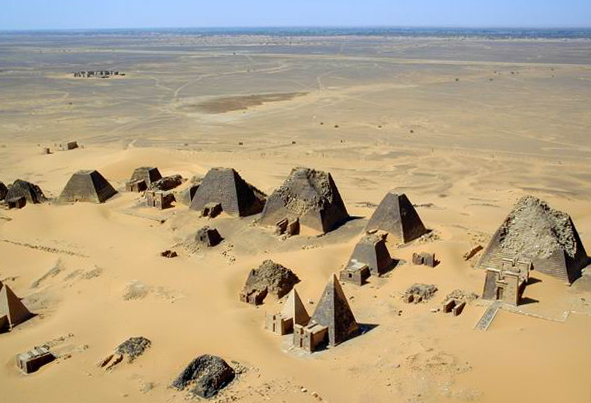
✦Sudan has more pyramids than Egypt: Meroe's 255 ancient Nubian pyramids, many unplundered, outnumber the famous Egyptian monuments.
✦The Nile flows north through Sudan for 1,600 kilometers; the Atbai Desert separates the Nile Valley from the Red Sea coast in one of Earth's most isolated regions.
✦Soba, an ancient Aksumite/Christian kingdom capital, was buried under Khartoum's expansion; archaeologists continue uncovering palaces and churches dating to the 6th century.
Ancient Nubian kingdom ruins with 40+ pyramids, temples, and royal necropolises in desert landscape.

Meeting point of Blue Nile and White Nile in Sudan's capital, viewed from the Toti Island
Earlier Nubian royal burial sites with pyramids and temples predating Meroe, near Jebel Barkal sacred mountain.
Sudan is the Nile's most extensive reach, stretching from the Sahara to tropical savanna, with Khartoum at the convergence of the Blue and White Nile. Nubian culture is distinctive and visible, with ancient kingdoms (Meroe, Kerma) leaving archaeological legacy. The northern deserts and Red Sea coast are remote. However, Sudan has endured political instability and conflict; tourism infrastructure is minimal compared to neighbors. Independent travel is challenging, and security concerns are significant. For travelers who do visit, the experience is rewarding: fewer tourists, warm hospitality, and genuine encounters.
Last checked 26 Jul 2026
Every zone below is rated against a named government advisory and carries the date we last read it. Most of any country is calmer than its headlines.
Avoid all travel
Government of Canada · checked 26 Jul 2026
Darfur region is affected by armed conflict, tribal tensions, and humanitarian crisis.
Avoid: Entire Darfur region; South Darfur, North Darfur, West Darfur states.
UK FCDO · checked 6 Jul 2026
Southern regions border South Sudan and face armed group activity.
Avoid: South Sudan border areas; Blue Nile state; parts of Upper Nile.
UK FCDO · checked 6 Jul 2026
Capital experiences periodic unrest, armed clashes between militias, and security force actions.
Avoid: Avoid large gatherings, protests, and political areas. Some neighborhoods (east Khartoum) are more volatile.
UK FCDO · checked 6 Jul 2026
Coastal regions face security challenges, smuggling activity, and militant presence.
Avoid: Red Sea coast, eastern borders with Eritrea.
UK FCDO · checked 6 Jul 2026
Police
999
Police, via the national emergency line
Ambulance
999
Ambulance, via the national emergency line
Fire
999
Fire service, via the national emergency line
Hospital
No national number
Fedail Hospital
Long before the pyramids most visitors picture, the upper Nile had already produced a city. At Kerma, on a bend of the river in what is now northern Sudan, an urban civilization rose around 2500 BC and lasted a thousand years, built around a river port and centred on a fired mudbrick tower known as the Western Deffufa, a monument that still stands some twenty metres high after four thousand years and is generally reckoned the earliest urban centre built anywhere in Africa outside Egypt. Kerma traded with, fought, and at times outmatched its northern neighbour, and its kings were buried under vast tumuli with retinues of sacrificed attendants, evidence of a state with its own court and its own theology rather than a satellite of the pharaohs. Kerma's successor kingdom is the one most people have half heard of: Kush. Centred first at Napata, beside the sacred mountain of Jebel Barkal where Kushite kings believed the god Amun himself lived, Kush grew powerful enough that in the eighth century BC its king Piye marched north and took Egypt outright, founding the Twenty-fifth Dynasty. For close to a century Kushite pharaohs ruled the length of the Nile from the Sudanese interior to the Mediterranean, until Assyrian invasions in the 660s and 650s BC pushed them back south. Kush kept going on its own terms for another thousand years. ...
The full history, the peoples, and pieces written by people from hereKhartoum sits at the confluence of the White and Blue Niles, a city that has endured siege and reinvention. The Sudanese are proud of their heritage, their music traditions, their literary culture. The economy has been battered by conflict, sanctions, and the loss of oil revenues after South Sudan separated. Recent political upheaval has added strain. Yet daily life continues: families gather for meals, markets hum with trade, young people dream of futures. The Nile Valley is still fertile, still sustains millions. The Sahara stretches endlessly. Sudanese hospitality is legendary, their coffee ceremony a ritual of connection, their food humble and nourishing. The country remains difficult for tourists due to security and infrastructure challenges, but those who have traveled there speak of profound warmth and an intensity of human connection.
Festivals and moments worth timing a trip around.
Celebrating Khartoum's role as Sudan's capital and crossroads, the festival features traditional music, dancing, and cultural exhibitions that showcase Sudanese heritage.
Among ancient royal tombs in the Sahara desert, concerts and celebrations honor Sudan's Nubian past and the kingdoms that once challenged the pharaohs.
Visitors explore the ruins of a medieval Islamic city while scholars, artists, and musicians celebrate Sudan's role in shaping African-Islamic civilization.
Sudan's literary tradition comes alive as writers, publishers, and readers gather along the Nile to celebrate Sudanese and African voices in writing.
Before you go
You have the zones as they stand today, and they do move, so when one in Sudan changes rating or an advisory we cite is rewritten, we will tell you. That is the only reason we will write.
