
Countrywide advisory (Government of Canada)
Exercise increased cautionExercise a high degree of caution
Government of Canada · checked 26 Jul 2026
 Public domain (Wikimedia Commons)
Western Africa
 Guinea
Guinea is a land of waterfalls, bauxite plateaus, and the Upper Niger source. A cultural crossroads where Fulani, Mandinka, and Susu traditions run deep.
✦Guinea produces one-third of the world's bauxite, yet most Guineans live without reliable electricity.
✦The Susu, Mandinka, and Fulani peoples maintain centuries-old oral traditions where griots preserve entire kingdoms in memorized song.
✦Kindia Falls plunges 80 meters through jungle so thick that mist rises like smoke even in dry season.
Guinea spans the transition from coastal mangrove swamps through lush Fouta Djallon highlands to savanna in the southeast. The landscape is dramatic: Kinkon Falls plunge from the Fouta plateau, and the Niger River is born in Guinea's interior peaks. The country is a mosaic of ethnic and linguistic cultures, with Fulani herding traditions, Mandinka griot song, and Susu fishing heritage all present in daily life. Village rhythms govern much of the interior, while Conakry's energy hums with street food vendors, music studios, and waterfront markets. Guinea offers the rare experience of vast interior regions that see few tourists yet remain culturally vital and strikingly beautiful. This is West Africa pre-globalization in many pockets.
Last checked 26 Jul 2026
Every zone below is rated against a named government advisory and carries the date we last read it. Most of any country is calmer than its headlines.
Exercise a high degree of caution
Government of Canada · checked 26 Jul 2026
The capital and surrounding towns are reasonably safe for visitors who exercise normal precautions. Petty theft and armed robbery occur, especially after dark and in isolated areas.
Avoid: Avoid traveling alone at night, avoid large public gatherings, avoid displaying valuables.
UK FCDO · checked 6 Jul 2026
Remote rural areas are less developed but generally peaceful. Road conditions are poor and basic services sparse. Travel is possible with local guides and advance planning.
UK FCDO · checked 6 Jul 2026
Police
No national number
Police, no functioning national line
Ambulance
No national number
Ambulance, no national dispatch
Hospital
+224 621 35 01 01
Clinique Pasteur
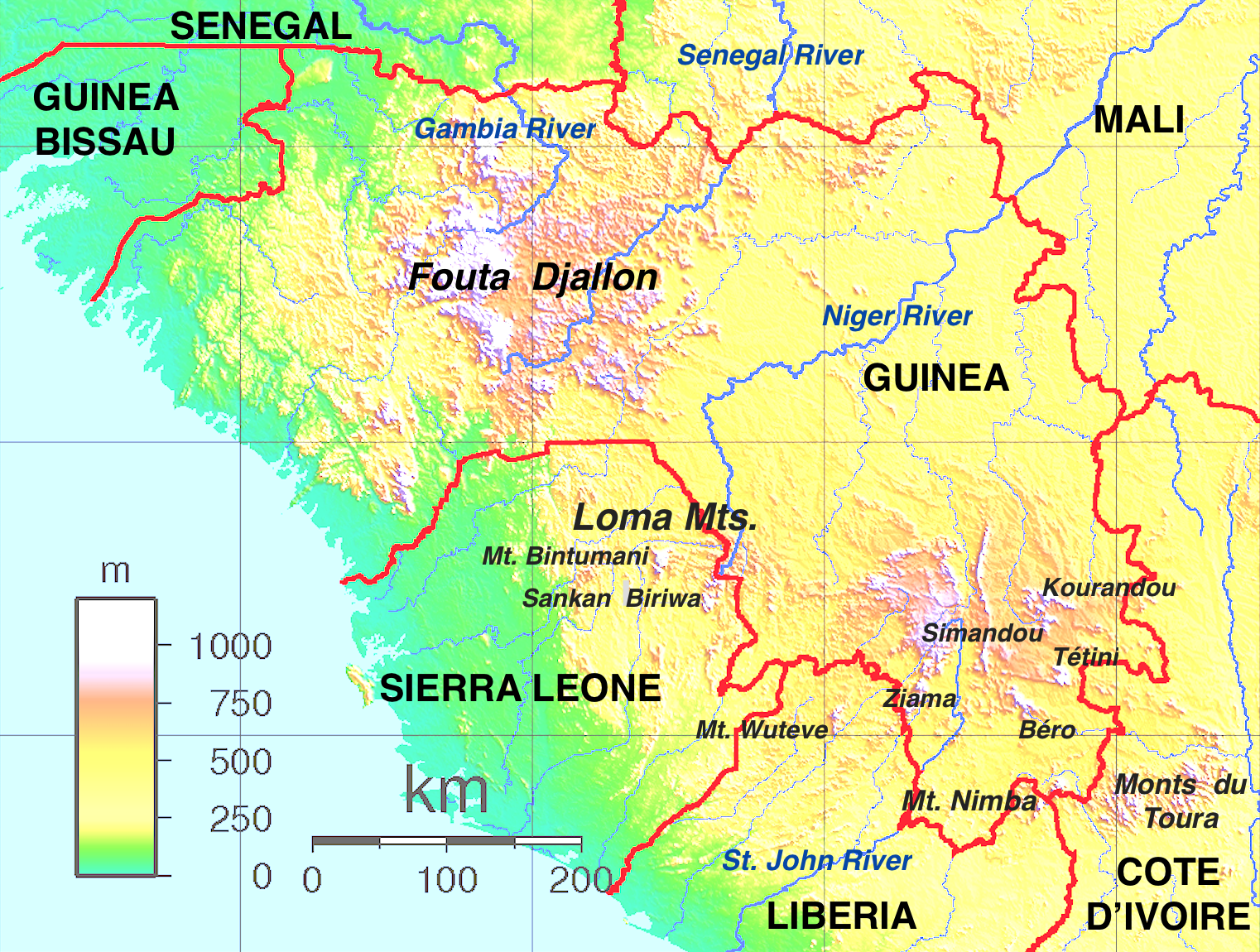
Guinea's history begins with water. In the Fouta Djallon highlands, at elevations high enough to be called West Africa's roof, the rain that falls each year becomes three of the region's great rivers: the Niger, which drains east toward Mali, Niger and Nigeria, the Senegal, which runs north, and the Gambia, which cuts west to the Atlantic. More than twenty West African rivers rise in this same block of granite and laterite. Everything Guinea has been, an empire's heartland, an Islamic state, a resistance stronghold, a mining economy, a one-party dictatorship, has happened on top of that water tower, and the shape of the land explains much of what the people built on it. The country divides into four natural regions, and each produced a different kind of society. Basse-Guinee, the narrow, mangrove-fringed coastal strip around Conakry, gave rise to small rice-farming and fishing peoples who worked tidal paddies with dikes and sluice gates. Moyenne-Guinee is the Fouta Djallon plateau itself, cool, pastoral and cut by gorges, the homeland of Fulani herders and later of an Islamic state. Haute-Guinee opens onto savanna and the upper Niger basin, a zone of trade routes and grassland kingdoms. Guinee Forestiere, in the southeast, is dense rainforest running into Liberia and Cote d'Ivoire, home to farming peoples organised around village and forest rather than around a central court. ...
The full history, the peoples, and pieces written by people from hereGuinea pulses with the rhythms of West Africa: Conakry sprawls across islands and peninsula, a coastal city of bustling markets, colorful tro-tros, and the salt-tinged energy of the sea. The economy runs on bauxite mining and agriculture, but life here is rooted in music, storytelling, and family bonds that bridge the distances. You'll hear the hypnotic kora and talking drums in neighborhoods where people gather in the evenings, sharing cassava leaves and joking in Fulani or Soussou. Guinea is rediscovering itself, with young artists and entrepreneurs driving cultural innovation, and the highlands remain one of West Africa's best-kept wilderness secrets, where waterfalls cascade and villages maintain traditions unchanged for generations.
Festivals and moments worth timing a trip around.
A celebration of Guinean music, dance, and culture that fills the capital with live performances, traditional exhibitions, and street parades. It's a moment when Guinea's artists showcase the country's rich artistic heritage to visitors and locals alike.
Guinea commemorates its bold 'No' vote of 1958 with parades, ceremonies, and cultural shows throughout Conakry. The day carries deep pride and reflection on the nation's unique path to freedom.
The highlands' cool, dry months draw trekkers to explore villages, waterfalls, and the dramatic landscapes of the interior. Local guides share stories of Fulani kingdoms and point out rare wildlife.
Guinea's Muslim majority observes Ramadan with prayer, fasting, and community meals, culminating in festive Eid celebrations with feasting, new clothes, and family gatherings throughout the country.
Before you go
You have the zones as they stand today, and they do move, so when one in Guinea changes rating or an advisory we cite is rewritten, we will tell you. That is the only reason we will write.
