Countrywide advisory (Government of Canada)
Exercise increased cautionExercise a high degree of caution
Government of Canada · checked 26 Jul 2026
 Lengai101 / CC BY-SA 3.0 (Wikimedia Commons)
Middle Africa
 Gabon
GabonGabon is an oil-rich rainforest nation with pristine national parks, Atlantic beaches, and a small population spread across vast wilderness. A destination for serious wildlife and nature exploration.
✦Gabon's rainforests are so intact that they're considered the Congo Basin's crown jewel; poaching is relatively rare.
✦The nation has more elephants than people, roughly 5,000 to 2 million humans.
✦Gabon's mangrove forests stretch along the coast, creating a natural fortress against the Atlantic.
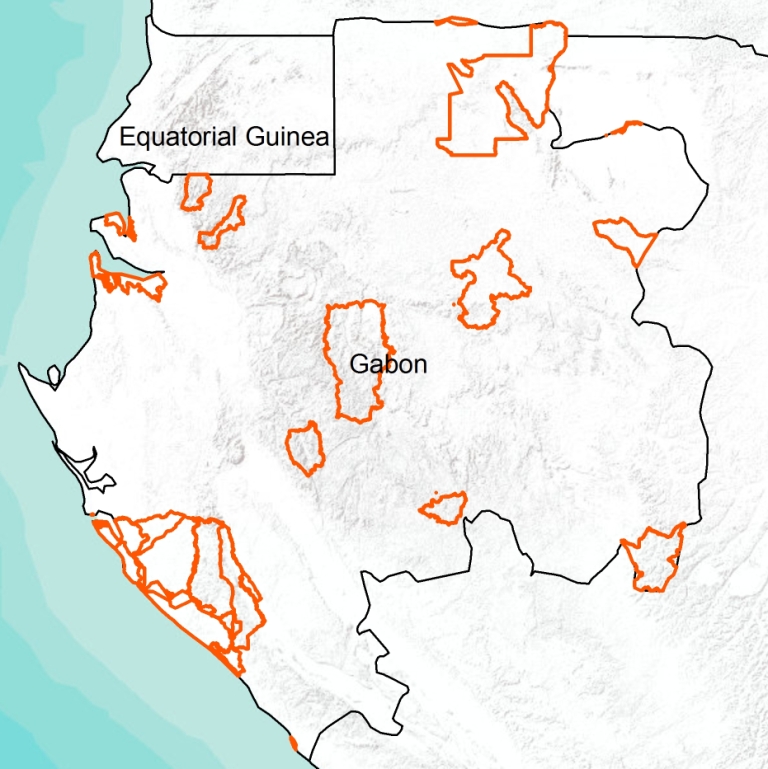
Pristine coastal rainforest reserve with forest elephants, buffalo, and deserted beaches; one of Africa's best wildlife destinations.
Rainforest reserve with waterfalls, gorillas, and dense jungle; highly biodiverse and less developed than Loango.

The capital's bustling waterfront, markets, and colonial architecture reflect Gabon's history and daily life.
Gabon is heavily forested; 85% is rainforest. Oil wealth has created a small middle class but left most of the country untouched. Libreville is the cosmopolitan capital; the interior is sparsely settled and pristine. National parks protect diverse ecosystems: Loango, Odzala, and Ivindo are among Africa's finest reserves, with forest elephants, gorillas, and unparalleled biodiversity. Culture is Bantu-based with strong Fang identity. French is widely spoken. Tourism is underdeveloped but steadily growing; infrastructure outside Libreville is basic. Gabon is politically stable by Central African standards.
Last checked 26 Jul 2026
Every zone below is rated against a named government advisory and carries the date we last read it. Most of any country is calmer than its headlines.
Exercise a high degree of caution
Government of Canada · checked 26 Jul 2026
Major cities are relatively safe and orderly. Street crime is less common than in other Central African capitals. Standard precautions required at night.
Avoid: Certain suburbs at night; unmarked areas.
US State Department · checked 6 Jul 2026
Parks are safe for organized tourism; wildlife is the main concern, not crime. Travel with licensed guides.
Avoid: Remote unmarked areas; travel only with organized expeditions.
US State Department · checked 6 Jul 2026
Stand almost anywhere in Gabon and you are close to the equator, which crosses the country near its geographic centre. What sets Gabon apart on a continent already generous with wilderness is how much of it remains under trees, since more than 88 percent of the national territory is rainforest, one of the highest forest cover ratios found anywhere on earth. At the heart of that green mass runs the Ogooue, Gabon's principal river, rising over the border in the Republic of Congo and cutting west across the country before emptying into the Atlantic, gathering the drainage of most of the nation as it goes. The Ogooue basin shaped everything that follows here, deciding who could move where, who controlled trade routes, and which peoples ended up on the coast and which stayed in the deep interior. Gabon also holds a piece of scientific history that almost no other country can claim, and that most guidebooks skip entirely. In May 1972 a technician at a nuclear fuel processing plant at Pierrelatte in France noticed something wrong during a routine mass spectrometry check, since uranium arriving from Gabon showed 0.717 percent of the isotope uranium-235, slightly below the 0.720 percent found in every other terrestrial rock, meteorite and lunar sample ever measured. ...
The full history, the peoples, and pieces written by people from hereLibreville rises from the coast as a surprisingly cosmopolitan capital: wide avenues, colonial architecture mixed with modern offices, excellent restaurants, and a relaxed pace that feels nothing like a major African city. The port hums with commerce; the oceanfront has sandy beaches. Inland, Gabon is mostly forest and small towns connected by rivers and logging roads. Logging has shaped the economy and landscape, but vast protected areas now preserve forest and wildlife. The people are urbane and welcoming, French-speaking, with a respect for the forest that runs deep. Food is good (fresh fish, cassava, tropical fruits), the music scene is alive, and the overwhelming feeling is of a nation not rushed, not overcrowded, still largely its own. The interior holds hiking, wildlife, and silence.
Festivals and moments worth timing a trip around.
Gabon's independence day with official ceremonies, parades, and street celebrations in Libreville and provincial capitals. The atmosphere is festive but measured.
Contemporary arts festival in Libreville showcasing Gabonese and African artists, musicians, and performers. Theater, dance, visual art, and cultural dialogue.
Events and exhibitions celebrating Gabon's protected forests, wildlife conservation, and the indigenous communities living within the green. Educational and inspiring.
Guided journeys to witness forest elephants, buffalo, and coastal wildlife in one of Central Africa's last great wilderness areas. Pristine and breathtaking.
Celebrations along the Ogooué River system honoring water, fishing traditions, and the river communities whose lives depend on these waterways.
Before you go
You have the zones as they stand today, and they do move, so when one in Gabon changes rating or an advisory we cite is rewritten, we will tell you. That is the only reason we will write.
